Song Dynasty China · 1100 AD · The Golden Age of the Kitchen
Juán Cǎo Fàn
The Song Dynasty (960–1279 AD) produced what food historians consider the most sophisticated restaurant culture the world had seen before the twentieth century. The capital Hangzhou, described by Marco Polo as the greatest city on earth, contained thousands of restaurants open twenty-four hours a day, serving dishes from every province of China. The market stalls of the city recorded in the Wulin jiushi — a twelfth-century memoir of Hangzhou life — include no fewer than fourteen distinct preparations of mushroom with grain.
The combination of garlic and mushroom, which appears in Chinese cooking records as early as the Han dynasty, was understood by Song cooks as a question of umami amplification: garlic and mushroom each contain significant quantities of glutamates, the compounds responsible for savory depth, and when cooked together they create a combined effect greater than either produces alone. The Song kitchens called this principle xian — a word that has no direct English translation but encompasses the idea of complex, layered savoriness.
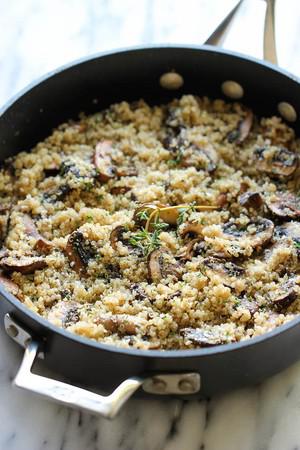
This preparation applies that principle to quinoa — a grain the Song Dynasty never encountered but would have immediately understood as a worthy vehicle for their mushroom and garlic tradition.